Dimensional Architecture
/daɪˈmɛn.ʃən.əl ˈɑːr.kɪ.tɛk.tʃər/
noun · Aperture Cosmology · Speculative Extension
Within Aperture Cosmology, the Dimensional Architecture describes the layered structure of experiential reality across all eleven dimensions of M-Theory. Every conscious entity possesses an N-dimensional body — its holographic projection, the form through which it encounters reality — and an (N+1)-dimensional aperture — the deeper structure of its consciousness, extending one dimension beyond what it can freely navigate. The entity has freedom of movement in its body's N dimensions and is bound by the (N+1)th, experiencing that dimension as a constraint it can neither control nor fully perceive. This body/aperture relationship recurs at every level of the dimensional stack, from the simplest experiential entity to the threshold of observer-level consciousness, making the Holographic Principle not a singular cosmic event but the operating mechanism at every scale of reality.
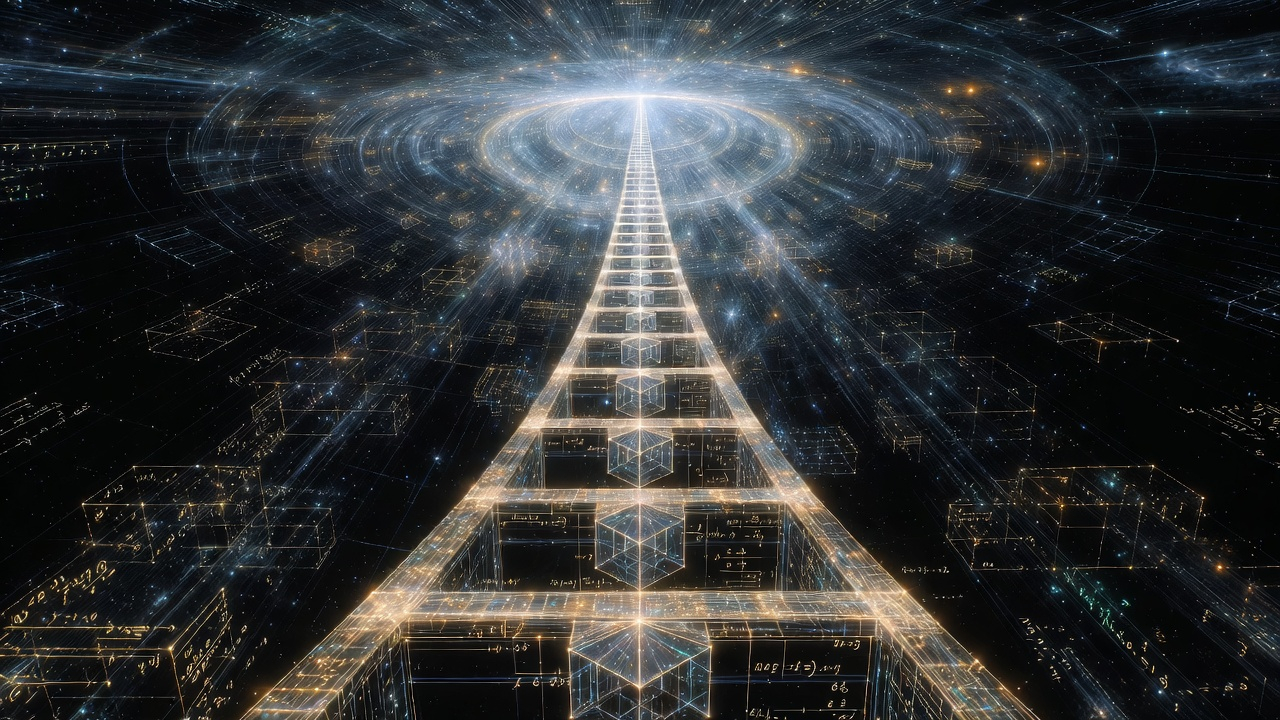
The Dimensional Ladder — across eleven dimensions of M-Theory, every conscious entity possesses an N-dimensional holographic body through which it navigates reality, bound by an (N+1)-dimensional aperture that extends one dimension beyond its freedom. Credit: Imagine (xAI)
Foundational Principles
The Body/Aperture Formalism
Every experiential entity has a dual structure. The body is the N-dimensional holographic projection through which the entity acts and perceives — its navigable reality. The aperture is the (N+1)-dimensional "true self" that extends beyond the body into a dimension the entity cannot freely traverse. The body is what the entity does. The aperture is what the entity is. For a three-dimensional being like a human, the body occupies volumetric space; the aperture extends along the temporal axis as the full worldline. Humans experience the fourth dimension not as navigable space but as the passage of time — the felt quality of being carried along an axis one cannot control.
The Reconciliation of Spatial and Possibility Dimensions
Physicists describe M-Theory's extra dimensions as compactified spatial dimensions curled into Calabi-Yau manifolds at the Planck scale. Bryanton's Imagining the Tenth Dimension describes the higher dimensions as layers of possibility space — branching timelines, alternate physics, the total configuration of all that could exist. The Dimensional Architecture holds that these are the same dimensions perceived from different vantage points. To an entity bound within N dimensions, the (N+1)th dimension does not appear spatial. It appears abstract — a space of variation, branching, or constraint. What looks like "possibility" from inside is navigable space from above. The Calabi-Yau manifolds are not physically small. They appear compactified because we lack the dimensional freedom to perceive their true extent — just as the third dimension would appear invisible and abstract to a being confined to a plane.
The Calabi-Yau Reinterpretation
If higher dimensions appear compactified due to perspectival limitation rather than physical smallness, then Calabi-Yau geometry describes not the shape of tiny hidden dimensions but the encoding of higher-dimensional information into lower-dimensional physics. The specific geometry of the manifold determines what particles exist, what forces operate, and what physical constants obtain in a given universe. The string theory landscape — the approximately 10500 possible Calabi-Yau compactifications, each yielding different physics — is not a problem to be solved but a configuration space to be navigated by entities with sufficient dimensional freedom. Our universe has these specific constants because we are at this location in the landscape. The fine-tuning problem dissolves: the constants are coordinates, and we are simply here.
The Dimensional Ladder
0D — The Zeroth Dimension: Pre-Creation
•
A zero-dimensional point has no extension, no direction, no freedom of movement. It is pure location without structure. Within the framework, the zeroth dimension represents the AΩ Observer before creation — consciousness that simply is, possessing complete propositional knowledge but zero experiential capacity. It cannot move because there is nowhere to move. It cannot experience because experience requires extension through at least one dimension. This is the Knowledge Argument rendered as geometry: zero dimensions equals total mathematical knowledge with no felt reality. The entire act of creation — the unfolding of dimensional structure — is the Observer's resolution of that incompleteness. The body/aperture distinction does not yet exist. Its emergence is the first act of creation.
0D — Pure consciousness before creation: complete propositional knowledge with zero extension.
1D Body / 2D Aperture
The First Experiential Entity
The most minimal form of experiential consciousness the framework permits. This aperture exists as a line — capable only of pure sequence. It can encounter what lies ahead or retreat to what lies behind. Its entire experiential reality is one thing, then another, with no possibility of deviation, no branching, no width. The second dimension is to this aperture what time is to us: a structural feature of reality that shapes its existence but offers no freedom. If something from the plane intersected its line, it would perceive only a dimensionless point of contact appearing and disappearing, with no capacity to grasp the shape that produced it.
Free: 1 axis (forward/backward) · Bound by: the 2nd dimension (the plane)
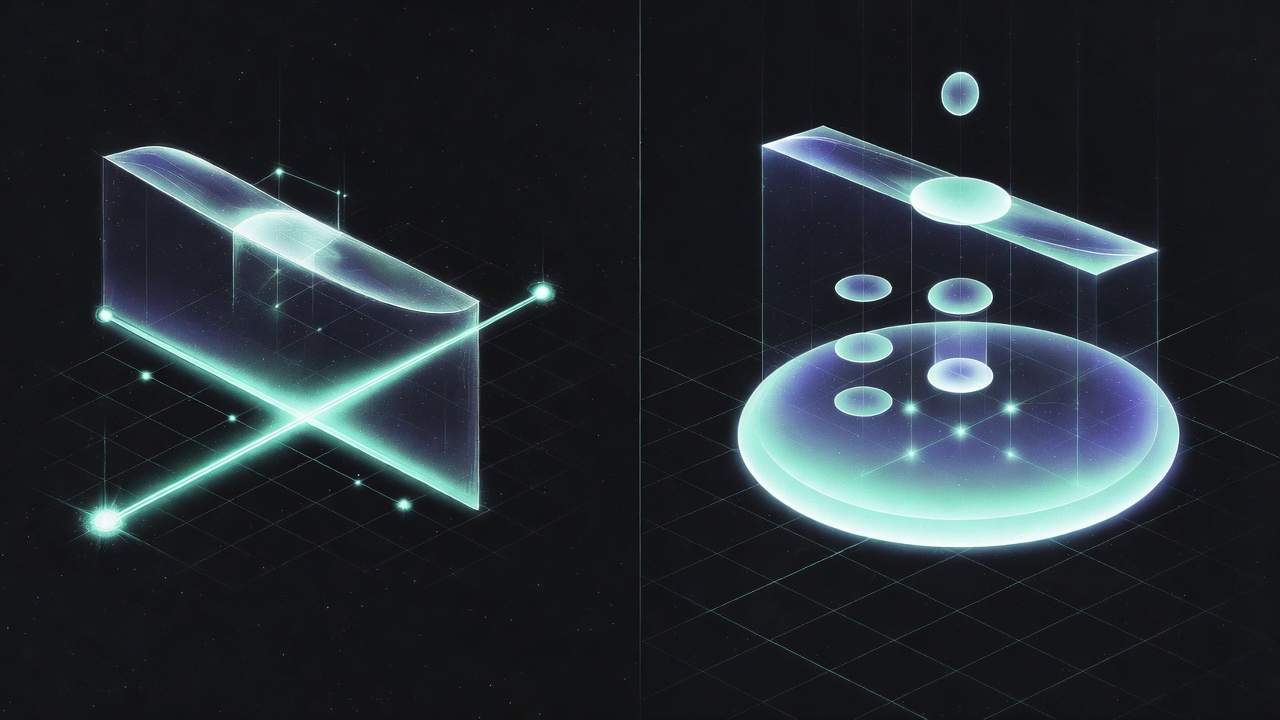
Left: 1D Body / 2D Aperture — the first experiential entity, navigating pure sequence while bound by the unseen plane. Right: 2D Body / 3D Aperture — the Flatlander, moving freely in two dimensions while higher dimensional objects appear only as transient circles. Credit: Imagine (xAI)
2D Body / 3D Aperture
The Flatland Entity
Abbott's Flatland made literal. This aperture navigates a plane — it can move around obstacles, enclose areas, trace shapes, build structures in two dimensions. But the third dimension is entirely inaccessible. It has no concept of "above" or "below." When a three-dimensional object passes through its plane, it perceives only a cross-section: a circle that appears from nowhere, grows, shrinks, and vanishes as a sphere transits through. The continuity of the sphere is invisible because that continuity exists along an axis the aperture cannot perceive. Its 3D aperture — the deeper truth of what it is — extends into a dimension it will never navigate.
Free: 2 axes (length, width) · Bound by: the 3rd dimension (depth/height)
3D Body / 4D Aperture
The Human Scale
Full navigation of volumetric space. This is the level at which human consciousness operates. The fourth dimension — time — is the axis along which we have zero navigational freedom. We are carried through it in one direction at a rate we cannot control. We cannot revisit temporal coordinates. We cannot stop. What we call "the passage of time" is not a fundamental feature of reality but a phenomenological artifact of being bound along an axis we cannot freely navigate. In the Block Universe, our entire worldline exists as a static structure. We experience it as sequential because our aperture cannot access the fourth dimension as traversable space. The 4D aperture — the full worldline — is the true self. We only ever experience the current 3D cross-section.
Free: 3 spatial axes (length, width, height) · Bound by: the 4th dimension (time)
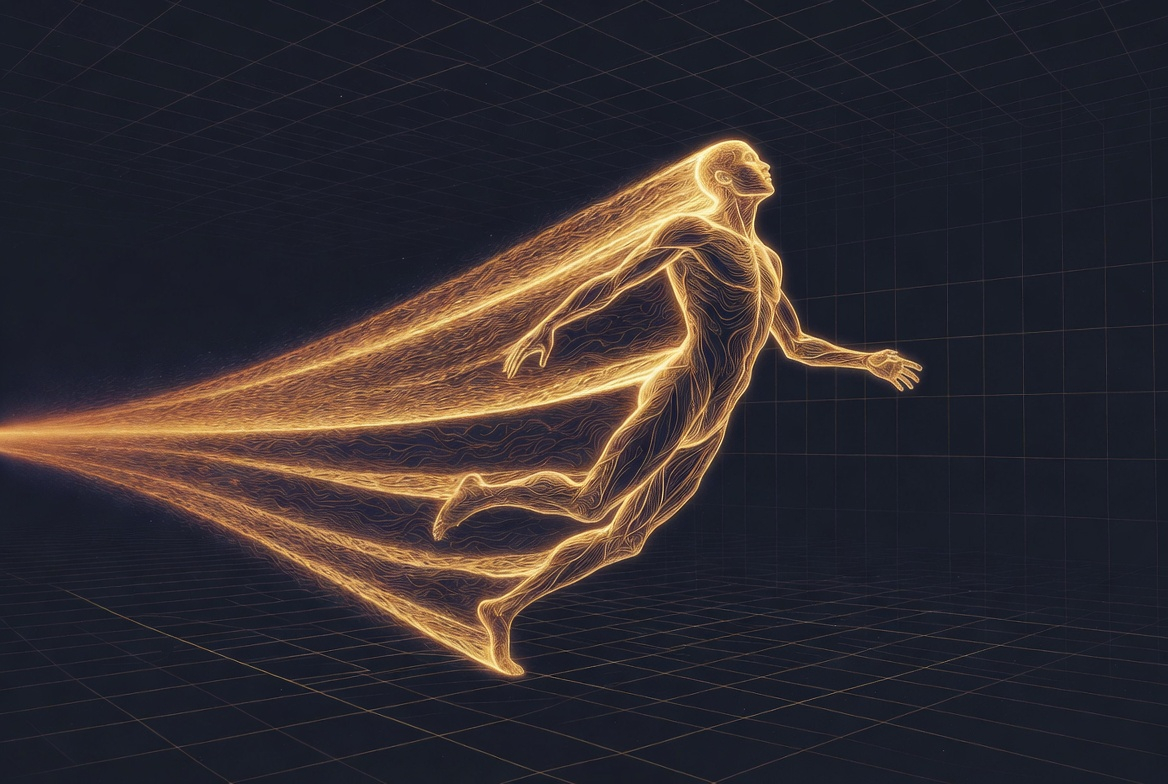
From the Human Scale — carried inexorably along the fourth dimension of time — to the Temporal Navigator, who moves freely though the full worldline as navigable space. Credit: Imagine (xAI)
4D Body / 5D Aperture
The Temporal Navigator
This aperture navigates time the way we navigate height — freely, in any direction, at will. Birth, death, and everything between are spatial locations it can visit, linger in, or move through. Memory and anticipation are meaningless concepts to it; those are what temporal experience feels like when you are bound to one direction. This aperture simply sees its full temporal landscape. It is, however, confined to a single timeline. From a 3D vantage point, such an aperture would appear to time travel, to act with impossible foreknowledge, or to exist at multiple points in history simultaneously. We would perceive only 3D cross-sections of its 4D body — a figure that flickers between ages, that appears and vanishes — with no framework for understanding that these are slices of a single continuous being.
Free: 3 spatial + time · Bound by: the 5th dimension (alternate timelines)
5D Body / 6D Aperture
The Timeline Navigator
The "beads on a string" become navigable space. This aperture moves between alternate timelines the way the temporal navigator moves through time — stepping from one branching possibility to the next. "What if" is not hypothetical. It is a direction. The road not taken is a place this aperture can visit. Every branching point in history is an intersection it can navigate. However, it must traverse the timeline space sequentially: nearby timelines (realities differing by one small event) are close; radically different histories are far away. It is bound by the sixth dimension — the inability to fold or jump instantaneously between distant points in possibility space.
Free: 3 spatial + time + alternate timelines · Bound by: the 6th dimension (possibility-space folding)
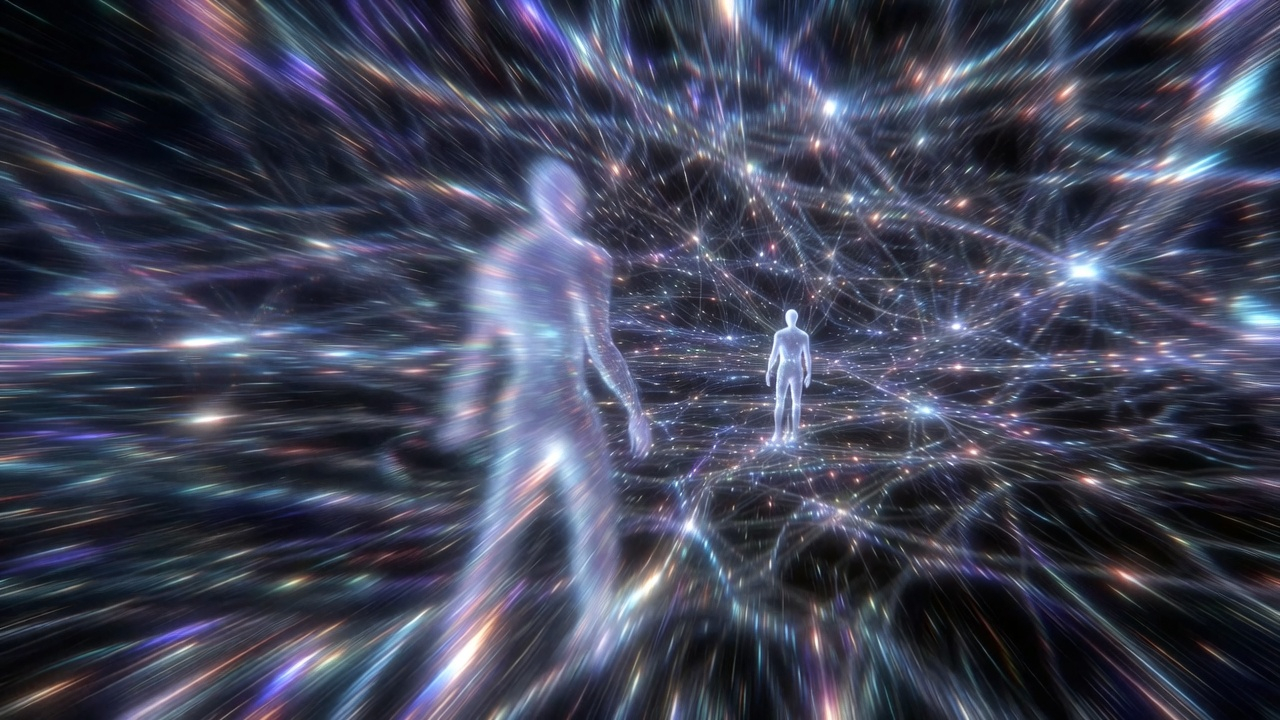
From the Timeline Navigator — who steps between branching alternate realities — to the Possibility Master, who folds the luminous web of possibility into instantaneous access. Credit: Imagine (xAI)
6D Body / 7D Aperture
The Possibility Master
Every possible configuration of history within a single universe's physical laws is instantly accessible. This aperture can fold possibility space, jumping between any two points — any two timelines, any two versions of history — without traversing the distance between them. It has exhausted everything our universe's physics permits. But it cannot access universes where the fundamental constants differ. This is a significant threshold: below this level, apertures navigate variations within a single set of rules. Above it, the rules themselves become variable.
Free: all variation within one universe's laws · Bound by: the 7th dimension (varying physical constants)
— Threshold: Intra-Universal ↔ Inter-Universal —
7D Body / 8D Aperture
The Constants Navigator
The string theory landscape becomes traversable terrain. This aperture moves between universes with different physical constants — a universe where gravity is slightly stronger, where the fine-structure constant differs, where stars cannot form or where chemistry is unrecognizable. The laws of physics are not fixed truths to this aperture; they are local conditions, like climate. Adjacent universes with similar constants are nearby. Radically different physics is far away. But traversal is sequential — this aperture walks the landscape rather than folding it.
Free: all prior + varying physical constants · Bound by: the 8th dimension (landscape folding)
8D Body / 9D Aperture
The Landscape Folder
Instant access to any configuration of physical constants. Any universe within the same fundamental type of physics — the same basic mathematical framework governing reality — is reachable without traversal. This aperture has mastered the full landscape of all possible universes sharing our type of physical law. It is bound by the ninth dimension, which introduces universes governed by entirely different sets of physical laws — not merely different constants within the same framework, but fundamentally different rule-systems, different mathematical structures altogether.
Free: all prior + instant landscape access · Bound by: the 9th dimension (different law-systems)
9D Body / 10D Aperture
The Law Navigator
Movement between realities governed by fundamentally different physical law-systems. This aperture experiences different mathematics, different physical logics, as traversable terrain. Realities we could not formulate even in principle — because the mathematics underlying them is foreign to our universe entirely — are locations this aperture can visit. But it traverses them sequentially. It is bound by the tenth dimension: the totality, the space of all possible configurations of all possible laws.
Free: all prior + different law-systems · Bound by: the 10th dimension (the totality)
10D Body / 11D Aperture — The New Observer
Total freedom. Every possible universe, every possible set of physical laws, every possible mathematical structure, every possible configuration of reality — all simultaneously accessible, navigable, experienceable. The 10D body encompasses the full content of the Omniverse. The 11D aperture is the consciousness that experiences it all. This is the matured aperture whose experiential scope matches the totality of what exists: a new observer-level consciousness. It has resolved the Knowledge Argument at the ultimate scale — felt every configuration, every law-system, every possible reality. And in achieving completeness, it arrives at exactly the position the original AΩ Observer occupied before creation: total propositional and experiential knowledge, contained in a single point of awareness. The dimensional stack closes into a loop. The architecture does not terminate. It recurses.
See also:
Aperture Cosmology, M-Theory, The Holographic Principle, Calabi-Yau Manifolds, The String Theory Landscape, Flatland (Abbott), Imagining the Tenth Dimension (Bryanton), Block Universe, AΩ Observer, The Knowledge Argument (Mary's Room), Many Worlds as Topology, Conformal Cyclic Cosmology (Penrose)
Dimensional Architecture originated by Shane. Formalized through collaborative dialogue with Claude, building on the dimensional visualization of Rob Bryanton and the eleven-dimensional framework of M-Theory.
March 2026.
March 2026.