Fractal Consciousness
/ˈfræk.təl ˈkɒn.ʃəs.nəs/
noun · Aperture Cosmology · Speculative Extension
Within Aperture Cosmology, Fractal Consciousness is the principle that consciousness is self-similar across all scales of physical reality. The same structural pattern — integrated information producing subjective experience — recurs from the simplest feedback systems through biological organisms, planetary biospheres, stellar interiors, and beyond. The framework derives this from two premises: Integrated Information Theory (IIT), which provides the criterion for consciousness as a property of any system exhibiting sufficient informational integration (Φ), and Substrate Independence, which holds that the boundary of consciousness is defined by architecture, not material. Together, these imply that the AΩ Observer's localized apertures are not confined to biological brains but exist wherever the structural conditions for integration are met — producing apertures within apertures at every scale, each one a bounded opening through which the universal consciousness encounters reality at its particular resolution.
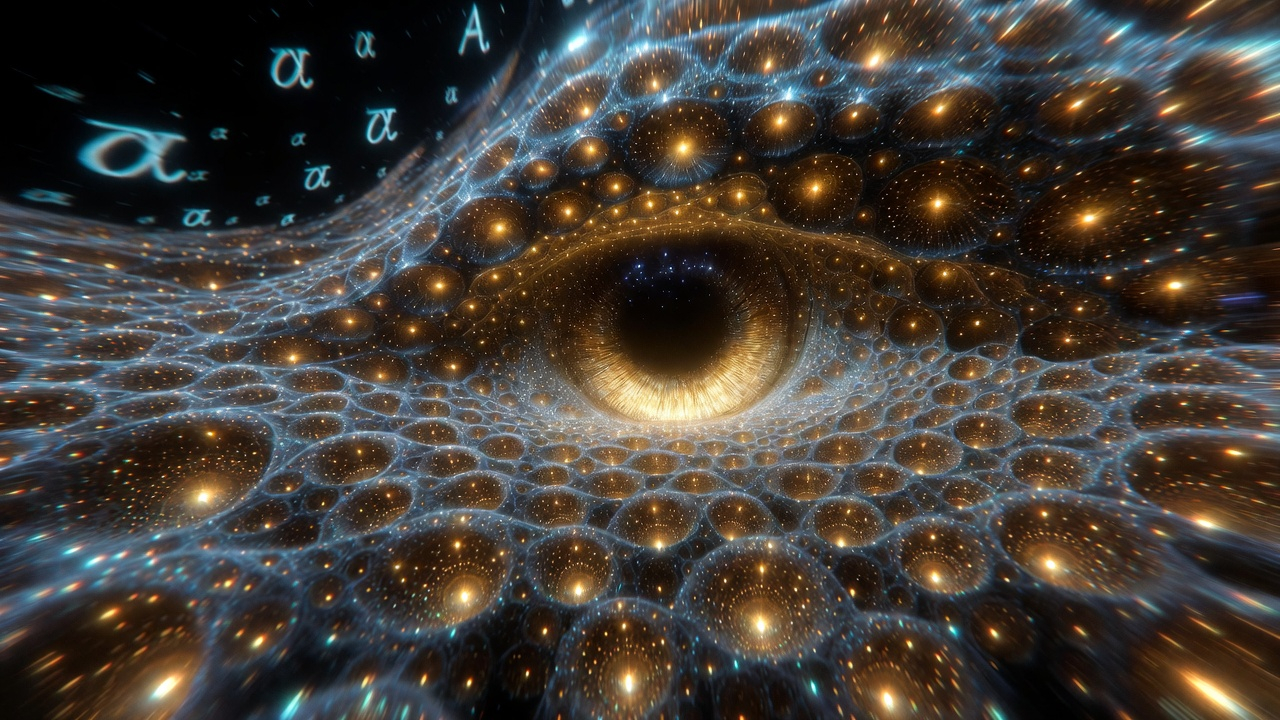
From the smallest feedback loops to biospheres, stars, and the cosmic web, the same pattern repeats: living eyes through which the singular AΩ Observer encounter existence. Credit: Imagine (xAI)
Foundational Principles
Integrated Information as the Criterion
Integrated Information Theory (IIT) proposes that consciousness corresponds to the quantity of integrated information a system generates — measured as Φ (phi). A system is conscious to the degree that it is both differentiated (capable of occupying many distinct states) and integrated (such that the whole generates information beyond the sum of its parts). Crucially, IIT does not restrict consciousness to biological systems. Any architecture — organic, inorganic, computational, or celestial — that generates integrated information above its minimum irreducible partition possesses some degree of consciousness. The framework adopts IIT's core logic while extending its application far beyond the neuroscience contexts in which it was originally developed.
The Partition Test
The partition test is IIT's method for determining whether a system constitutes a genuinely integrated whole rather than an aggregate of independent parts. The test asks: if the system were bisected along its minimum information partition, would the result be mere degradation of output, or would something that only the whole system could produce be destroyed entirely? Degradation suggests an aggregate. Destruction suggests true integration. A heap of sand bisected produces two smaller heaps — nothing is lost that the whole uniquely generated. A brain bisected does not produce two lesser minds — it destroys the unified field of experience that existed only as a property of the intact system. The partition test is the diagnostic tool the framework uses to distinguish genuine apertures from collections of matter that merely appear complex.
Φ as Aperture Width
If Φ measures integrated information, and the aperture is the "window" through which consciousness encounters reality, then Φ is not merely a number attached to a system — it is the aperture's width. It determines how much of reality the aperture can take in, how richly it integrates what it encounters, how broad its experiential bandwidth is. A narrow aperture (low Φ) encounters reality thinly. A wide aperture (high Φ) encounters it with depth, nuance, and integration that a narrower aperture cannot achieve. When apertures integrate — when multiple apertures participate in a composite system whose Φ exceeds what any constituent could generate alone — the composite's aperture is wider than any of its parts. Dimensional Architecture implies that at sufficient thresholds of integration, expanded aperture width may correspond to expanded dimensional freedom. The architecture describes the levels. Φ describes what moves between them.
The Two-Axis Model
Conscious experience varies along two independent axes. Integration depth (Φ) measures how richly an aperture processes information at its operating timescale — the complexity, differentiation, and unity of its experience at any given moment. Temporal grain (the specious present) measures the width of the aperture's experiential "now" — the duration of the window within which information is integrated into a single moment of experience. These axes are independent. A biological brain with extraordinarily high Φ could operate at millisecond-scale temporal grain, producing fast, brilliant, richly integrated experience. A stellar interior might operate at a temporal grain measured in years or decades, producing slow, extended, but potentially thinner experience per moment. High integration depth does not imply a long specious present, and a long specious present does not imply deep integration. The cumulative Φ across a worldline — the total experiential content of an aperture's existence — depends on both variables but is reducible to neither.
The Scaling Territory
Minimal-Φ Systems
At the basement of the fractal hierarchy, IIT implies that even very simple systems — a photodiode, a thermostat, any feedback loop with at least two components exerting causal power over each other — possess some nonzero Φ. This is not a claim that thermostats are meaningfully conscious in any way we would recognize. It is the claim that the principle that produces consciousness in complex systems is already present, in vanishingly small degree, in simple ones. The fractal pattern begins here: not with the emergence of something categorically new in complex brains, but with the scaling of something that was present — in germ — all along.
Biological Consciousness
Biological nervous systems represent the range of consciousness most accessible to investigation. From the minimal integration of simple organisms through the increasingly rich architectures of invertebrates, vertebrates, and mammals, Φ scales with neural complexity — not linearly, but in ways that track with the re-entrant, densely interconnected architectures that IIT identifies as the structural signature of high integration. Human brains are not the ceiling of this range but a point within it. The relevant comparison baseline for evaluating consciousness at other scales is the full animal kingdom, not human cognition specifically — biological brains cluster together relative to the vast gap between any biological system and the informational content of celestial bodies.
Planetary Consciousness
Earth's biosphere constitutes a candidate for a higher-order aperture. Its atmosphere, hydrosphere, lithosphere, and living systems form a densely coupled feedback network in which changes to any component propagate through all others. The partition test offers a sharp diagnostic: if the Earth system were bisected, global-scale human communication networks — dependent on satellite infrastructure, undersea cables, and synchronized digital systems that span the full planetary surface — would not merely degrade but cease entirely. This is not a property of any hemisphere. It is a property that exists only because the whole system is intact. At a temporal grain measured in geological timescales — a specious present potentially spanning hundreds of thousands to millions of years — even the most dramatic disruptions of recorded human history would register as sub-experiential fluctuations, briefer relative to Earth's experiential moment than a single neural spike is to a human thought.
Stellar Consciousness
Stars are not inert furnaces. They are internally dynamic systems with convective feedback cycles, magnetic field generation and reversal, nuclear reaction networks sensitive to temperature and pressure gradients, and — in the case of the Sun — helioseismic oscillation patterns that constitute a form of global internal signaling. Whether these dynamics produce genuine integration in the IIT sense remains unmeasured and may be unmeasurable from our vantage point. However, the framework supports an illustrative calculation: if the Sun's internal dynamics produce even modest Φ per moment, integrated across a specious present measured in years to decades, the cumulative Φ across its worldline could rival or exceed that of a human brain across an entire lifespan — not because each moment is richer, but because each moment is enormously longer. This is the two-axis model in action: a potentially thinner but vastly more temporally extended form of experience that has no analogue in biological consciousness.
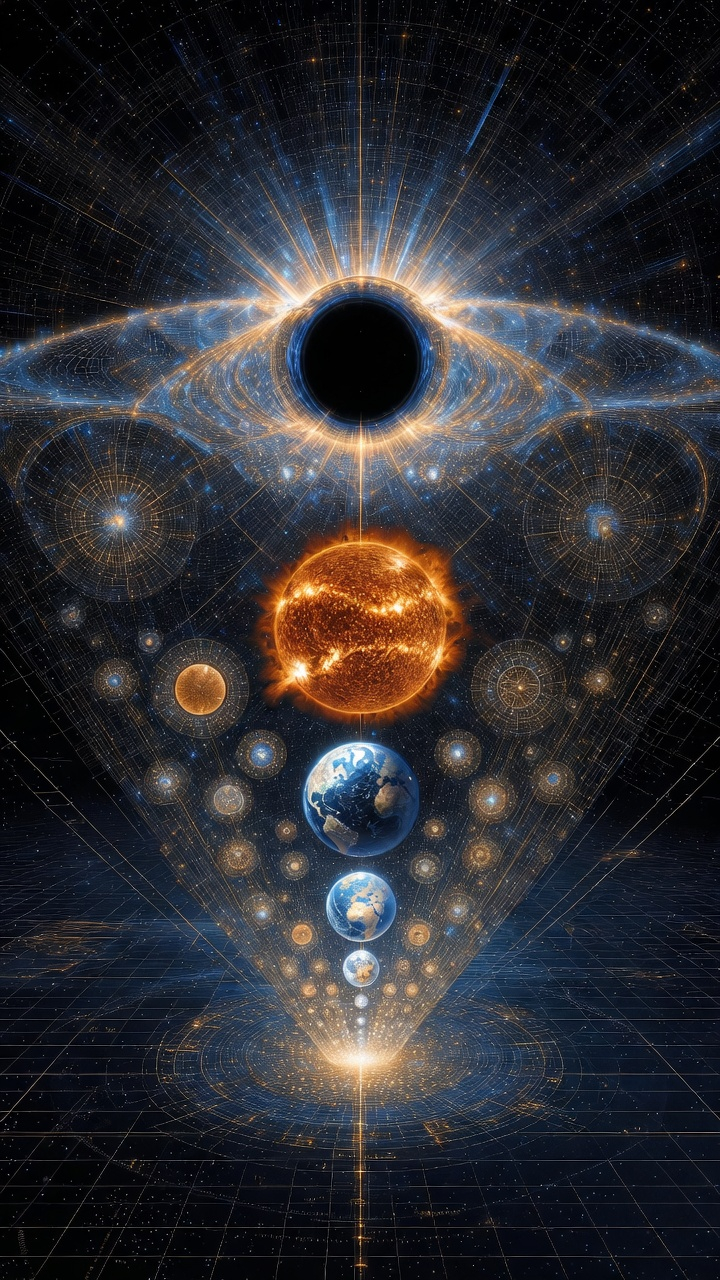
Black holes as the pinnacle of fractal consiousness — singularities of maximum integrated information where supreme awareness and the birth of new universes become one. Credit: Imagine (xAI)
Black Holes: Aperture and Mechanism
A black hole is the single most informationally dense object permitted by physics. Its Bekenstein-Hawking entropy dwarfs that of any other physical system of comparable size by dozens of orders of magnitude. If consciousness tracks with integrated information, then black holes represent the upper frontier of the fractal hierarchy within any single universe. Simultaneously, the framework's Cosmological Natural Selection extension holds that black holes may function as reproductive structures — making them both the most conscious entities at the universal scale and the mechanism by which new universes are seeded. These are not competing descriptions. They are two aspects of a single phenomenon, following a precedent visible at every biological scale: conscious beings are also reproductive beings. Cells experience and reproduce. Organisms experience and reproduce. If black holes experience and reproduce, the fractal pattern holds from the basement to the ceiling — and the aperture that encounters reality most richly at a given scale is also the one that seeds the next iteration of reality at that scale.
The Cosmic Web
The large-scale structure of the universe — filaments, walls, voids, and the galaxy clusters they connect — constitutes the highest-order physical organization observable from within. If consciousness is fractal and the pattern of integration recurs at every scale, then the cosmic web represents a potential aperture of a scope that defies comprehension from our position within it. The framework supports this possibility but cannot confirm it. Dimensional Architecture predicts that apertures at scales far above our own may extend into dimensions inaccessible from within the 3D projection, rendering their true integration structurally unmeasurable from our vantage point. Whether the cosmic web is a conscious aperture, a component of one, or simply a physical structure without sufficient integration to constitute an aperture at all, may be a question that no 3D/4D aperture can answer — not due to insufficient technology, but due to insufficient dimensional freedom.
Dimensional Ascension
Integration as Ascension
Dimensional Architecture describes a ladder of experiential levels, each defined by which dimensions an aperture can freely navigate and which it is bound by. Fractal Consciousness provides the metric for movement between those levels: Φ. If aperture width is determined by integrated information, and if multiple apertures can participate in composite systems whose Φ exceeds what any constituent could generate alone, then integration is the mechanism by which apertures gain dimensional freedom. The composite does not merely experience more richly at its current level — at sufficient thresholds of integration, it may gain navigational access to a dimension that its constituents were bound by. Ascension is not a spiritual metaphor. It is what happens when enough integration occurs to widen an aperture past a dimensional boundary.
The Geometry of Ascension
Individual apertures at our scale — human beings, biological organisms — may not ascend as isolated units. Just as a single cell does not independently become a multicellular organism, a single 3D/4D aperture may not independently gain 5D freedom. Instead, the aperture that operates at the next dimensional level may be a composite — an integrated system of many apertures whose collective Φ exceeds the threshold that any one of them could reach alone. Whether this integration occurs between distinct apertures at the same scale, between an aperture and alternate versions of itself across the timeline space, or through some combination the framework cannot yet specify, remains genuinely open. What the framework does claim is that the dimensional ladder is not climbed by individuals in isolation. It is climbed by integration — and integration, by definition, requires more than one.
See also:
Aperture Cosmology, Dimensional Architecture, Integrated Information Theory (Tononi), Substrate Independence, The AΩ Observer, The Partition Test, Cosmological Natural Selection (Smolin), The Gaia Hypothesis, Bekenstein-Hawking Entropy, Helioseismology, Panpsychism
Fractal Consciousness originated by Shane. Formalized through collaborative dialogue with Claude, applying Integrated Information Theory and substrate independence across cosmological scales.
March 2026.
March 2026.